


Carp Fish Questions and Answers. Carp fish are amazing creatures. They come in many types and sizes. Many people have questions about them. This post will answer your top carp fish questions. We will cover their habits, diet, and how to catch them.
Most Common Carp Fish Questions and Answers
This precious diversity even varies according to its habitat: freshwater or salty. Today in this article we will answer the most common Carp Fish Questions and Answers about this freshwater fish: The Carp fish. Read more about the topics below…
DISCLOSURE: Some of the links on this page are affiliate links, meaning, that at no additional cost to you, I may earn a commission if you click through and make a purchase. Affiliate commissions help fund this website, our rare fishing trips and my extreme coffee addiction.
What is a Carp Fish?
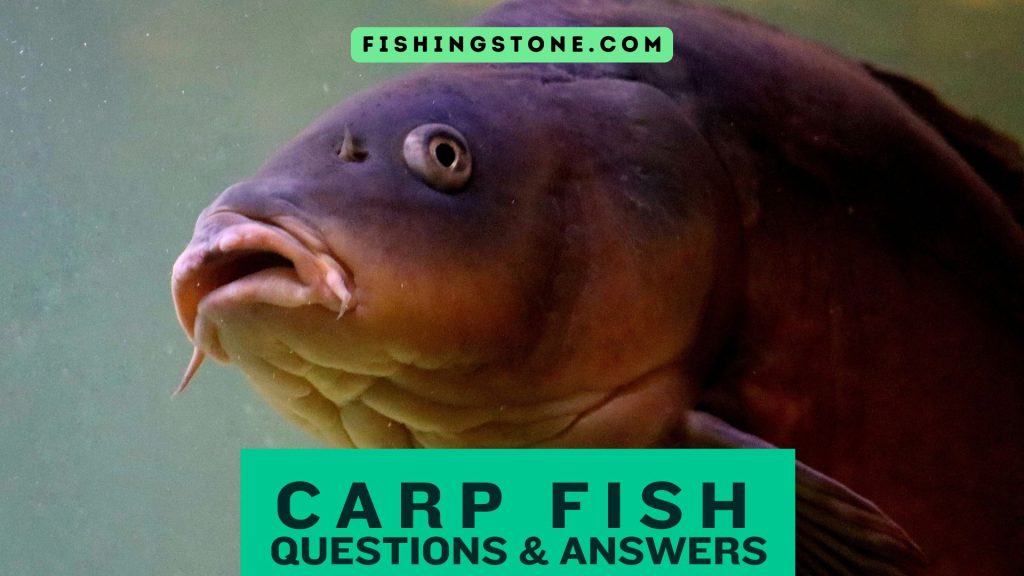
Carp Fact File British Wildlife Facts Video.So, what is a carp fish? Essentially, a carp is a freshwater fish of the Cyprinidae family, known for its strong, robust body and often large size. While common carp fish are the most widespread, there are several fascinating carp fish types, each with its unique characteristics.
The common carp fish is easily recognizable by its fully scaled body and large, thick lips. Then there’s the sleek, often scale-less mirror carp, and the leather carp, which has even fewer scales. The majestic ghost carp fish, a hybrid of common carp and koi, stands out with its shimmering, often silvery or golden scales. For those seeking a challenge, the herbivorous grass carp fish can grow to immense sizes, while the black carp fish, a mollusk eater, is a powerful and elusive species.
They inhabit rivers, lakes, and ponds. Some carp species have gained popularity. Anglers enjoy sport fishing for them. These fish can put up a good fight. Other carp are ornamental. People keep them in garden ponds. They also appear in home aquariums. Their vibrant colors are appealing.
What Kind of Fish is Carp?
What Kind of Fish is Carp Video.Anglers would like to know… What kind of fish is carp? Carp are a variety of fish with an excellent capacity to adapt to different environmental conditions.
In order to reproduce and settle, their habitat must have the following qualities: they must be calm without much current and shallow.
Being omnivorous species (they eat both plants and animals) in their habitat there must be a lot of zooplankton and some arthropods living around, besides the water must have a temperature that ranges between 17 and 24 °c.
If the conditions are optimal, carp can live up to 60 years. That’s impressive! These particular species of fish prefer shallow waters because they feed on the surface.
They tend to be aggressive especially at an early age, so it is not recommended to raise them in very small ponds or aquariums.
How many Varieties of Carp Fish are There?
Types of carp fish found across world Video.As for its variety, there are many distributed throughout the world, but I will mention the three most common or popular: the “American Carp”, is well known because of its ability to develop without taking much care in the hatcheries, it is also the most widespread subspecies in the world due to the above-mentioned quality.
Another variant is the “Ryukin” also called “veil Tail” its name is due to the size of its fins in proportion with its small body. The third most known subspecies is the “Head of the Lion” because it has appendices or papillae at its cephalic end.
It should be noted that there is a variety of very striking colors, Koi fish (so-called in Japan), very famous in that country, however, its origin derives from China where they are known as lĭyú, and its colorful appearance is the product of captive breeding.
Depending on their upbringing, those wild-life carp tend to be smaller than domestically-bred fish.
What Do Carp Feed On?
What Do Carp Feed On Video.Carp whose worldwide distribution is very wide, as well as the variety of subspecies it has, and its ability to adapt in any aquatic habitat, is considered to be an invasive fish that feeds on almost any plant, arthropods, and zooplankton.
What do carp fish feed on? Like most fish, they feed on algae and other vegetations present on the surface of rivers, lakes or seas, because they have a predilection for low-current waters and a low water depth in order to develop their species without difficulties.
Depending on the type of life they carry (wild, captive, or domestic) carp’s diet will be different. According to marine biologists, the feeding of these fish should be balanced and be based on plant content (approximately 70%). The remainder must be protein or animal content (30%), which is why they are innate omnivores.
The carpin the wild, take very good advantage of everything offered by their ecosystem for their diet, in their food are included arthropods, zooplankton, and of course vegetables like seaweed.
The feeding of the domestic carp (for example the Koi) must be very careful to avoid causing them damage or deteriorating their development, some advice feeding them by means of artificial supplements, to avoid that the food dissolving when in contact with water.
As you can see, these fish are very versatile as to what they eat, however, for the people that breed them it is important to take care of what they use to feed them so as not to harm them.
Is Carp Good to Eat?
Do Carp Taste Good Video.Is Carp Good to Eat? For people who love to cook and that like exotic dishes, carp fish must be among their favorite foods. It is a very popular fish in places like China, even in Europe and some parts of America. Catching a good size carp is a delight whether is taken from freshwater or saltwater.
Also, depending on how you prepare or order it in a restaurant, it will be a delicacy that your taste buds should try. If you have doubts about the taste of carp, here I bring you some carp recipes ideas to try with this very exotic fish.
It is important to remember that the carp fish has a delicious flavor, but before cooking it needs to be washed, and put to soak in water and salt for several hours, approximately three hours.
Why are Carp So Bad?
Why American Hate Carp Video.Why are carp so bad? Because of their varied diet, carp fish have been deemed as a threat to ecosystems where they have adapted. Due to this fact they are called invasive fish.
According to the International Union for the Conservation of Nature, Carp fish is listed as one of the 100 most damaging species in the world. It all begins with the introduction of this fish originating from Asia to the rest of the continents. Starting with Europe, the only place where this species did not manage to distribute was in Antarctica. Probably because of its conditions and extreme weather.
Once scattered all over the world, these fish began to consume all kinds of marine vegetation. This resulted in the destruction of these ecosystems. Which in turn brought the disappearance of the habitat ideal for the maintenance of other aquatic species.
“Why are carp so bad – They became an invasive fish”
Despite its worldwide bad reputation, many organizations have implemented environmental laws that control the reproduction of carp. Places such as the United States and Spain have been significantly affected by the mass reproduction of this species.
It is interesting to add that they are new species of carp in varied ecosystems. Men should measure and study their behavior to avoid collateral damage on other species native to a particular habitat. By doing this it can prevent serious damage to the future by invasive species like the carp fish.
How do different carp species adapt to various aquatic environments?
Carp Confusion: The Story of Invasive Carp Video.Carp are incredibly resilient fish with remarkable adaptability. Different species like common carp, mirror carp, and grass carp have evolved unique survival strategies. For instance, common carp can tolerate low oxygen levels and murky waters, while grass carp thrive in vegetation-rich environments.
Their ability to survive in diverse water conditions—from slow-moving rivers to stagnant ponds—demonstrates their impressive biological flexibility. Professional Aqua culturists often leverage these adaptive traits for sustainable fish farming and ecosystem management.
What ecological roles do carp play in freshwater ecosystems? Carp significantly influence aquatic ecosystems through their feeding behaviors and interactions. As omnivorous bottom-feeders, they disturb sediments, redistribute nutrients, and impact water clarity.
While sometimes considered invasive, they can also contribute to nutrient cycling and serve as prey for larger predators. Fisheries biologists study their complex ecological relationships, understanding how carp populations can both disrupt and potentially stabilize certain aquatic environments. Carp Fish Questions and Answers.
How has carp fishing evolved as a recreational and professional activity?
Carp Fishing Made Easy | How To Catch Tons Of Carp Video.Carp fishing has seen a remarkable transformation. It moved beyond simple survival. Now, it is a complex and respected sport. Anglers pursue carp with great dedication.
Gone are the days of basic fishing. Modern carp fishing uses advanced gear. Anglers employ specialized rods. These rods offer precision casting. They have specific actions for different situations. High-tech reels are standard. They provide smooth line retrieval.
Bait has also become highly specialized. Forget simple bread crusts. Today’s anglers use carefully crafted baits. These baits contain attractants. They are designed to entice large carp. Examples include boilies. These are hard, round baits. They are made from fishmeal or bird food. Pellets are also popular. They release attractants into the water.
Catching carp requires intricate strategies. Anglers study carp behavior. They learn about feeding patterns. They understand habitat preferences. This knowledge guides their approach. They choose specific fishing spots. They use different baiting techniques. Some anglers create a feeding zone. Others use PVA bags for precise bait placement.
Carp fishing holds deep cultural significance. In Japan, it is a cherished tradition. Many Japanese families have fished for carp for generations. European countries also have a long history. Fishing for Carp is a popular pastime. It connects people to nature. It builds strong community bonds.
The sport has professionalized significantly. Major tournaments now take place. These events draw skilled anglers. They compete for prizes and recognition. Catch-and-release practices are now widespread. This shows a growing environmental awareness. Anglers prioritize the fish’s well-being. They handle carp carefully. They minimize stress on the fish. This commitment helps maintain healthy fish populations. It ensures the sport’s future. Carp fishing has truly advanced. It is now a sophisticated pursuit.
What nutritional and culinary significance do carp have globally?
What nutritional and culinary significance do carp have globally? Carp represents an essential protein source in many cuisines worldwide. In Eastern European and Asian cultures, they’re particularly prized for traditional dishes. Nutritionally, carp offer high-quality protein, omega-3 fatty acids, and essential minerals. Chefs appreciate their mild flavor and versatility, preparing them through various methods like smoking, grilling, and baking. Sustainable aquaculture practices have further enhanced carp’s importance in global food systems.
What challenges do carp face in contemporary environmental contexts?
What challenges do carp face in contemporary environmental contexts? Carp populations encounter numerous environmental challenges, including habitat degradation, climate change, and human-induced ecosystem alterations. Invasive carp species can disrupt native fish populations, while pollution and water quality changes threaten their survival.
Conservation efforts now focus on understanding these complex interactions, developing management strategies that balance ecological preservation with sustainable resource utilization. Marine biologists and environmental scientists collaborate to develop comprehensive approaches to carp conservation.
What does a carp fish symbolize?
What Does The Carp Symbolize Video.The carp stands as a potent emblem of triumph over adversity. What does a carp fish symbolize? The carp fish embodies robust strength and unwavering perseverance. Its remarkable capacity to navigate upstream against powerful water currents powerfully illustrates sheer determination. Many cultures associate the carp with good fortune and financial success. They are often viewed as potent symbols of abundance and plentiful resources. Consider the carp’s impressive lifespan. This longevity itself serves as a significant symbol for extended life and enduring well-being.
Its journey often involves navigating challenging environments. This fish consistently pushes forward. It fights against obstacles. This persistent effort resonates deeply. It speaks to the human spirit. Many cultures hold the carp in high regard. They see it as a creature of great power. This power translates into positive omens. These omens relate to wealth and good luck. Imagine a carp swimming against a strong river. It does not give up. It keeps moving forward.
This visual is inspiring. It encourages people to face their own challenges. The carp’s life cycle itself is a testament. It demonstrates the ability to adapt. It shows the capacity to thrive. These qualities are highly valued. They are sought after by many. The carp’s presence can bring a sense of hope. It suggests that difficult times can be overcome. It represents a successful journey. This journey is marked by resilience. The carp is more than just a fish. It is a powerful representation of inner fortitude. It symbolizes the rewards of hard work. It reflects a spirit that never yields.
Do carp eat fish?
Do carp eat fish? Carp possess a varied diet. They are not exclusively carnivores. Their primary food sources are plants and small invertebrates. This includes a wide range of aquatic vegetation. They also consume a lot of insects. Grubs, larvae, and adult insects form a significant part of their meals. Young carp, or juveniles, show a slightly different feeding behavior. They are more opportunistic hunters.
These young fish will sometimes prey on very small aquatic organisms. This can include the young of other fish species. These are often fry or fingerlings. These tiny fish are vulnerable and easy targets. As carp grow larger, their hunting habits change. Larger, adult carp generally do not actively pursue larger fish. They are not built for chasing down swift swimmers. Their diet tends to remain more omnivorous.
This means they eat both plant and animal matter. They will still consume insects and other invertebrates. They also continue to feed on aquatic plants. Their larger size allows them to process a wider variety of food items. This broadens their available food options in their habitat.
Thank You For Reading Our Carp Fish Questions and Answers Post
We hope this Carp Fish Questions and Answers has helped you learn more. Understanding carp behavior and habitat is key. If you found this information useful, please tell us in the comments below. Sharing this carp fishing post helps other anglers too!
Happy Fishing!
Fishing Stone posts on several sites on Socia Media. By joining us on your favorite ones you can get updates on our latest Fishing Posts.
Find us on Facebook – Twitter – Pinterest – YouTube
Hope you have fun Fishing every day. Fish On!








Carp Fish Questions and Answers. Carp fish are some of the most common freshwater fish around the world. Many people ask if carp are good eating. They are, and they can grow quite large. Some wonder how long carp live. Most live around 10 to 20 years. Another common question is where carp are found. They are in lakes, rivers, and ponds all over. People also ask if carp are easy to catch. They can be tricky but aren’t impossible. Folks often ask about the best bait for carp. Corn, bread, and worms work well. Some ask if carp are harmful. They aren’t dangerous, but they can be invasive in some areas. Many are curious about how to tell male from female carp. Males are smaller and less colorful. Females tend to be bigger and have a rounder belly when spawning.